Gisela Berger · 14 September 2026
How Specialized Root Networks Stabilize Coastal Sediment During Seasonal Flood Cycles
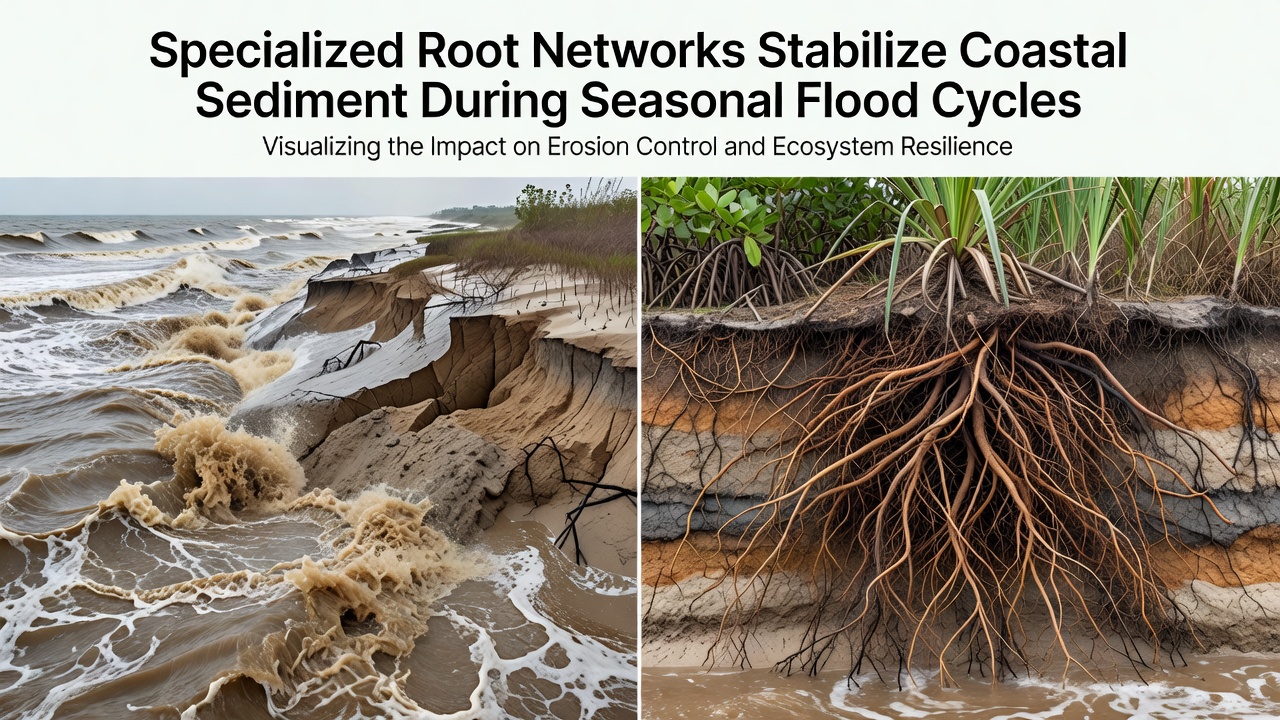
Coastal ecosystems rely on specialized root networks from vegetation such as mangroves, salt marsh grasses, and seagrasses to anchor sediment against the forces of seasonal floods, and these structures create physical barriers that reduce water velocity while trapping particles carried by currents. Observers note that root systems in these environments extend both horizontally and vertically, forming dense mats that bind loose particles into more stable layers over time.
Root Architectures in Coastal Vegetation
Mangroves develop prop roots and pneumatophores that penetrate deep into muddy substrates, whereas salt marsh species like Spartina alterniflora produce fibrous underground networks that spread laterally across the surface. Researchers have documented how these adaptations differ by region, with tropical systems emphasizing aerial roots and temperate zones favoring rhizomatous growth that spreads through repeated seasonal cycles. Data from long-term monitoring shows root density increases in areas exposed to regular inundation, allowing the plants to respond to varying water levels without losing their hold on the sediment below.
Seagrass meadows contribute additional stabilization through their rhizome mats, which lie just beneath the sediment surface and create a lattice that resists scouring from wave action. Experts tracking these patterns report that root biomass in such meadows can reach several kilograms per square meter in mature stands, providing cumulative reinforcement as individual plants expand and connect over years.
Mechanisms of Sediment Retention
Roots reduce flow speeds near the bed, causing suspended sediments to settle rather than continue moving downstream during flood events, and the same structures then hold those deposits in place once water levels recede. Studies indicate that root hairs and fine laterals increase surface area for particle adhesion, while larger structural roots prevent wholesale removal of the top sediment layer. This dual action operates continuously across tidal and seasonal scales, with the greatest effects visible when floodwaters carry higher sediment loads from upstream sources.
One study along the northern Australian coastline revealed that areas with intact root networks retained up to three times more sediment after monsoon-driven floods compared with cleared sites, according to measurements collected by the Commonwealth Scientific and Industrial Research Organisation. The findings highlight how root architecture interacts with local hydrology to create self-reinforcing sediment platforms that elevate over successive flood seasons.
Performance Across Seasonal Flood Cycles
During peak flood periods, root networks dissipate energy from elevated water flows and storm surges, limiting the depth of erosion that would otherwise strip away accumulated layers. In the months leading into September 2026, satellite and field data from multiple basins show that vegetated shorelines experience measurable accretion even after intense rainfall events, whereas bare sediments continue to lose material. The timing of these cycles aligns with regional climate patterns, where spring snowmelt or summer monsoons deliver the strongest pulses of water and sediment.
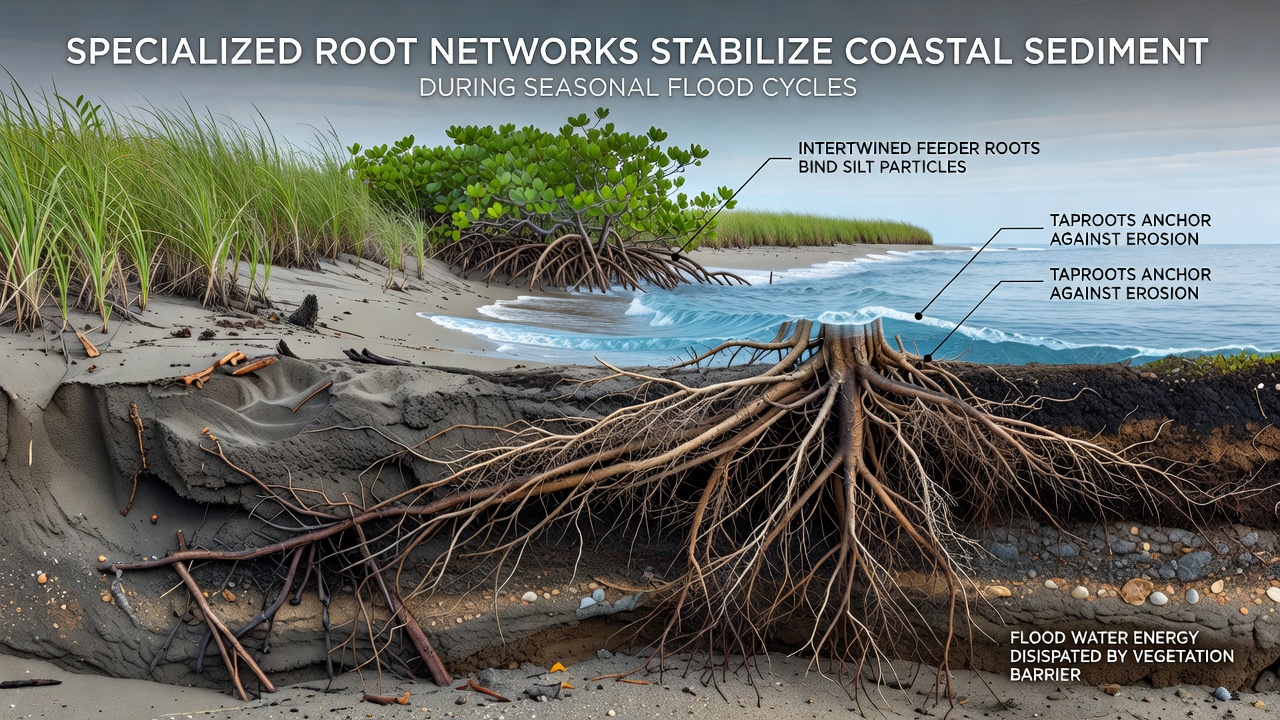
Researchers tracking post-flood recovery note that roots continue to trap finer particles as water velocities drop, gradually rebuilding elevation in depressions created by earlier scouring. This process repeats annually, with each cycle adding incremental stability provided the vegetation remains undisturbed. Evidence from sediment core samples demonstrates layered deposits that correspond to known flood years, confirming the role of roots in preserving stratigraphic records of past events.
Regional Observations and Supporting Data
Along the Pacific coast of Canada, monitoring programs have recorded similar retention rates in estuarine marshes during winter storm seasons, with Environment and Climate Change Canada datasets showing reduced shoreline retreat where root density exceeds threshold levels. These measurements align with observations from other temperate zones, indicating that the underlying mechanisms operate consistently despite differences in plant species and flood timing.
Additional work in Southeast Asian deltas has quantified how root networks interact with varying sediment grain sizes, demonstrating that finer clays adhere more readily to organic surfaces while coarser sands require the mechanical interlocking provided by larger roots. The combined effects produce stable platforms capable of withstanding repeated inundation without net loss of material.
Conclusion
Specialized root networks in coastal vegetation maintain sediment stability through physical binding, flow modification, and particle trapping that function across seasonal flood cycles. Measurements from multiple continents confirm these processes operate reliably when vegetation cover remains intact, producing measurable differences in sediment retention compared with altered shorelines. Ongoing monitoring programs continue to document these interactions as flood patterns shift with changing climate conditions.